
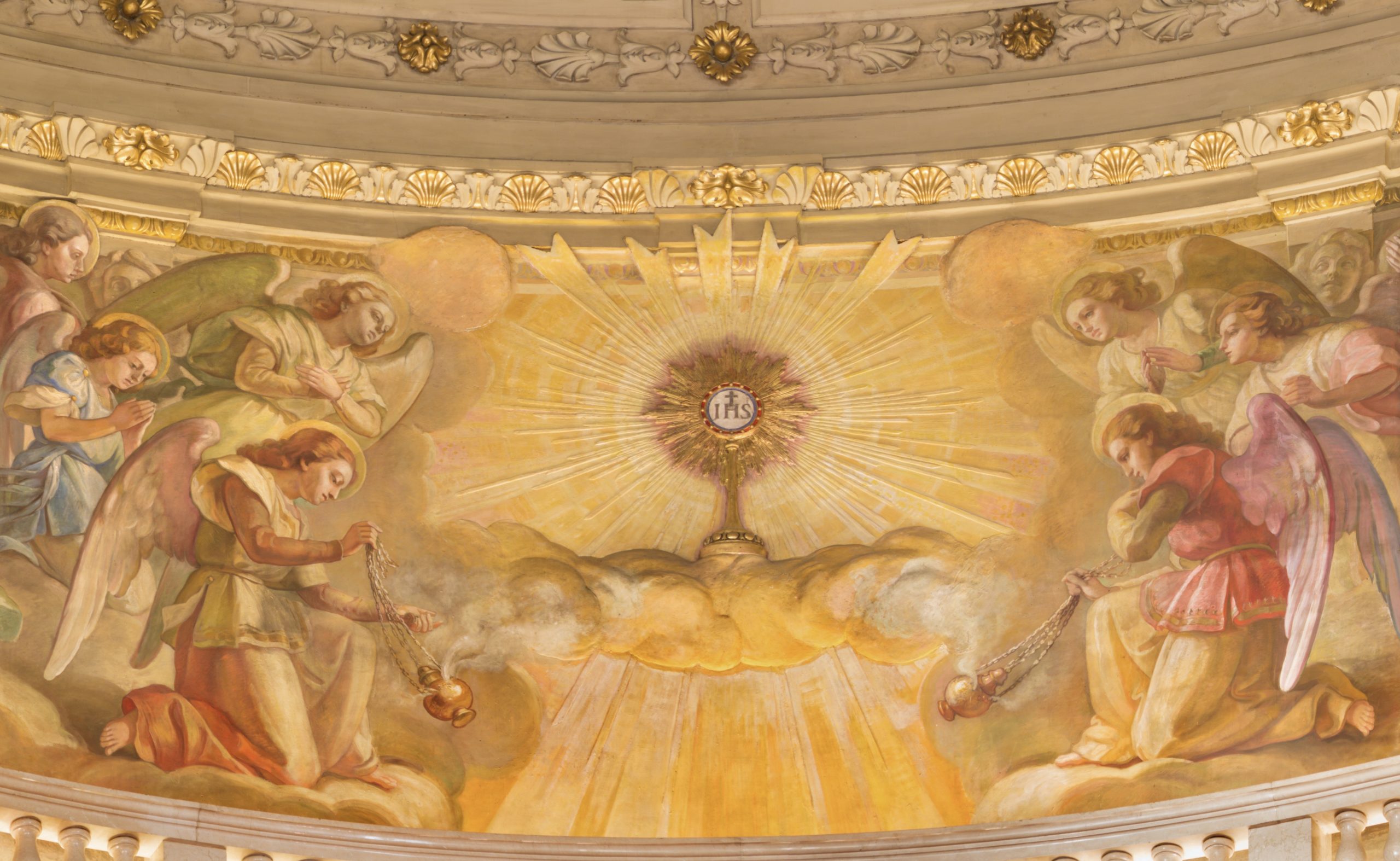
Eucharist

From the Question Box: If Jesus is in the bread, why do we eat Him? This question touches the heart of our faith and ponders the very nature of who God is and what His relationship with us is.  The people of Jesus’ time asked this question as well.  To begin to understand this mystery, which is the very center of our faith, we need to contemplate several theological truths. First, consuming the Eucharist is not cannibalism.  The Catechism of the Catholic Church tells us in paragraph 1367 that the sacrifice of Christ and the sacrifice of the Eucharist is one and the same, although the manner of offering is different.  The Eucharist is a non-bloody sacrifice.  The Eucharist makes present the sacrifice of the Cross and applies its fruit: everlasting redemption (CCC#1366). Second, we consume the Eucharist because Jesus told us to do so.  Jesus reveals the Eucharist to us in John 6: 51 – 58: “I am the living bread which came down from heaven. If any one eats of this bread, he will live for ever; and the bread that I will give, is my flesh, for the life of the world. The Jews then disputed among themselves, saying: How can this man give us his flesh to eat? Then Jesus said to them: Amen, amen I say unto you: Unless you eat the flesh of the Son of man, and drink his blood, you have no life in you. He who eats my flesh, and drinks my blood, has eternal life: and I will raise him up in the last day. For my flesh is food indeed: and my blood is drink indeed. He that eats my flesh, and drinks my blood, abides in me, and I in him. As the living Father has sent me, and I live because of the Father; so he that eats me, will live because of me. This is the bread that came down from heaven. Not as your fathers ate and died; he who eats this bread, will live for ever.” To comprehend what He is telling us, we need to look at God’s revelation to us in the Old Testament.  We must realize that the entire Bible should be viewed as one book, one tapestry if you will.  Just as colors are woven into a beautiful cloth and each color enhances the entire picture and contributes to the images, so too each book of the Bible contributes to our understanding of the truths God has revealed.  One must look at the entire Bible to understand the context and meaning of each book.  Just as removing one color from the tapestry removes depth, beauty, and meaning from the picture, so too we need every book in the Bible to understand what God is revealing to us. Our first encounter of bread and wine being offered is in Genesis when Melchizedec, the King of Salem (Salem means peace and we refer to Jesus as “the Prince of Peace”), appears to…

Continue ReadingEucharist

Forgive Us Our Sins

As we forgive those who sin against us.  When we pray the Our Father (also known as The Lord’s Prayer), we always mean the first part, but do we really mean the second part?  If we are honest with ourselves, we all squirm a little on this one.   We all want to be forgiven, but extending that forgiveness to those who have hurt us or our family members is much more difficult.  So, is this “forgive us as we forgive others” a lofty ideal to which we aspire, or is absolutely essential that we do it?  Can we do it? The Church is full of examples of heroic virtue, including modern saints like Mother Teresa (now St. Teresa of Calcutta) and Pope St. John Paul II. These saints often seem so high above us that we often think “Oh, I’ll never make it that far,” even though they were people just like us who simply chose to love God.  So today I am writing about an ordinary person that inspired me: Betsie TenBoom. I learned about Betsie in high school when I read The Hiding Place by Corrie TenBoom.  Corrie recounts how she and her sister Betsie, devout in their Dutch Reformed faith, chose to hide Jews from the Nazis after the invasion of Holland.  When the Nazis stormed the TenBoom home, they didn’t find the hidden Jews but they did find the extra ration cards which were illegal to possess.  Betsie and Corrie were sent to Ravensbruck, a concentration camp. Miraculously, they smuggled in their Bible and shared their faith with many who had lost hope. Betsie maintained a disposition of gratitude, even thanking God for the fleas because it kept the guards out of their dormitory so they could read the Bible to their fellow inmates undisturbed. Betsie always told Corrie “no hate” and continually prayed for the souls of the guards even though she was  frequently beaten by them.  Even Corrie was amazed at Betsie’s forgiving heart and steadfast focus on God.  As she lay dying in the infirmary, she told Corrie, “When you leave here you must tell people that there is no pit so deep that God’s love is not deeper still.  They will believe you because you have been here.”  These words have remained with me my whole life. Forgiveness is possible, but why is it so necessary that Jesus devoted several parables to it?  Forgiveness is more about us than it is about those who have wronged us.  When we choose not to forgive, we hold onto anger for so long that it turns into either rage or depression.  We then harm not the transgressor, but those around us as well as ourselves.  Forgiveness does not  mean letting the transgressor “get away with it,” it means letting ourselves get away from it. Forgiveness is an act of the will.  We will ourselves to forgive.  By choosing to put down this burden we carry, we free ourselves to open our arms wide to receive…

Continue ReadingForgive Us Our Sins

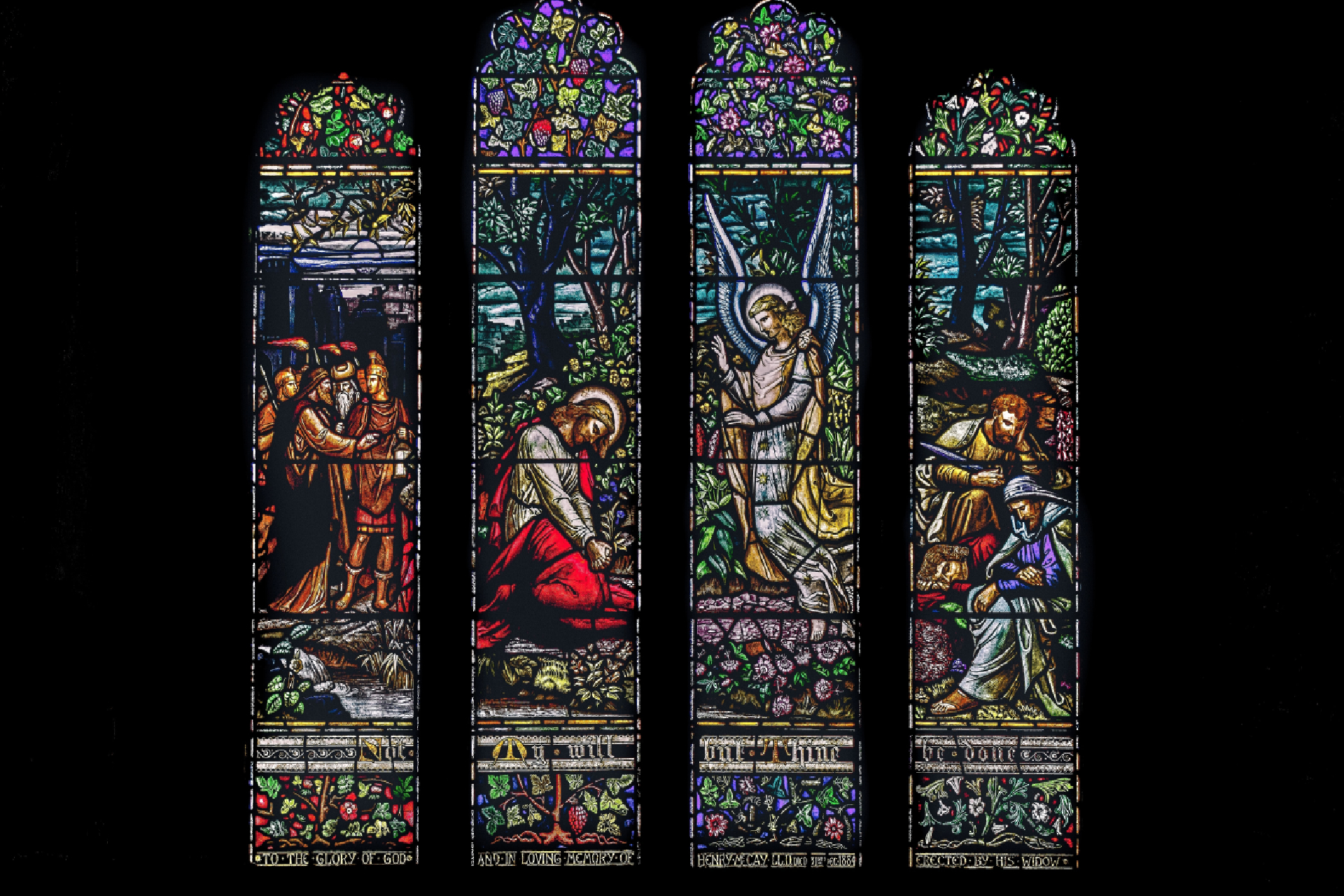
Gethsemane

We all know the events that took place in the garden of Gethsemane: Jesus prayed, the apostles slept, Judas betrayed Him, and He was arrested.  But we really don’t know what happened in the garden.  Our understanding must begin with reflecting on what sin does to our souls.  Sin darkens the intellect, separates us from the love, truth, and beauty that is God, and strangles the breath from our souls.  The sorrow is that the longer we remain in sin, the more we become accustomed to the darkness and the lack of breath.  We can even go so far as being impressed with our own “wisdom,” lying to ourselves that we have our own light.  The deeper we go into sin, the more our souls gasp for air and the more we search in all the wrong places for relief and for light. It was into this darkness that Our Lord descended when He took on the sins of the whole world -- and this suffering truly goes beyond human understanding.  Eternally perfect, descending from Heaven into a body free from all stain of sin, living in perfect love and communion with the Father with every breath of His life, to suddenly have all of our sins heaped upon Him caused so much physical agony that He sweat blood.  Pause for a moment with that thought.  He sweat blood.  No other human being has ever suffered this much. But even this was not the worst.  He actually felt everything we feel after we sin: guilt, shame, unjust anger when our sins are pointed out to us, sorrow, abject misery, desolation, and the worst of all – the emptiness that is felt by those who are so immersed in the deepest pits of sin they can no longer feel anything.  These are the ones so engulfed in evil that at the moment of death they look at the face of God with such hatred that they leap willingly into the fires of hell.  Yes, Jesus felt all these things – the pain beyond bearing and the reason why the angel rushed to His side. Jesus loves us so much that He willingly endured all of this. Jesus’s depth of compassion for us poor sinners has no bounds.  He understands everything we are suffering and desires to free us from the personal hells we create for ourselves when we sin.  He delights in forgiving us, especially those in most need of His Mercy. When we humble ourselves to ask for forgiveness, Jesus looks beyond the filth and stench we have heaped upon our souls.  He looks with compassion and mercy on souls writhing in agony.  He sees the heavy chains that have weighed us down for so long that we have long since stopped trying to move.  He sets us free.  As He promised, He never rejects a contrite heart.  He rejoices in forgiving us, setting us free from our chains, seeing our souls breathing freely and reflecting God’s light as the…

Continue ReadingGethsemane

Sunsets

Each of us has a love language, a way that our beloved communicates with us so that we feel loved.  For some it may be the words “I love you,” for others it may be little gifts or thoughtful gestures that say “I was thinking of you,” and for others it may be big, warm hugs.  For me, God communicates with me through nature, most especially through sunsets.  Every time I see a beautiful sunset, I know that He is saying “I love you” to me. I spoke with my husband a few days ago about the ongoing shelter in place and the fact that I hadn’t seen a sunset in a long time because we have been inside so much.  The very next evening I glanced out the window and saw the most beautiful pink sky.  I raced outside and saw God’s “I love you” in all its breathtaking glory.  The air around me was pleasantly warm  -- the heat that remains after a scorching day but has tempered to a balmy warmth.  It felt like God’s warmth was wrapping around me and hugging me. So I composed this little prayer for Him as a thanksgiving for the sunset.                             Son of God, I praise you, I bless you, I adore you                             Until You come again                             Near to You I will remain.  Keep me in the center of Your                             Sacred Heart,                             Embracing me with Your love.  Jesus, I                             Trust in You.

Continue ReadingSunsets

End of content

No more pages to load