Are You Saved?

This is the question I was asked as I opened my front door to a smiling man from a Protestant church.  I admired his courage in going door to door and his obvious love for God.  He expected a yes or no answer to his question, but he came to a Catholic home, and the answer is much more complex. Just as there are differences in language between Americans and our friends across the pond (for example, we say “backyard” and they say “garden”), there are also differences in language between Catholics and Protestants that have evolved over the last 500 years.  Many of these differences come from differences in theology, so I will begin here. Protestant (denominational and non-denominational) theology thinks of salvation as a singular point in time in which the Christian officially accepted Jesus Christ as his personal Lord and Savior. Protestants sometimes say “name it and claim it,” referring to the promises Jesus has made in scripture to those who follow Him. If Protestant theology on this topic can be thought of as a point on a line, Catholic theology is a ray (an origin point on a line continuing in one direction forever).  For Catholics, salvation begins at Baptism. At Baptism one becomes a member of the Christian community, a member of the family of God.  Original sin and personal sin are wiped away.  We believe in one Baptism, so if a person is baptized “In the name of the Father, the Son, and the Holy Spirit” whether in the Catholic or Protestant faith, it is valid. Baptism is the beginning of the journey for Catholics.  We learn and grow in our faith as we are nurtured by our families and our faith community.  We read scripture, pray, attend weekly Mass, receive the sacraments of the Church, and do our best to live the Gospels.  We take to heart Jesus’s own words, “Truly, truly I say to you, he who believes in Me will also do the works that I do,” (Jn 14:12) and “If you love Me, you will My commandments (Jn 14:15).”  It is for this reason that the Catholic Church and its members founded the university system[1], started credit unions, founded hospitals and schools, and is active in ministering to the poor through many organizations such as St. Anthony’s Dining Room and the St. Vincent de Paul Society.  We recognize that by serving others, we are serving Christ (Mt 25:40).  Yet, all of us are human; we make mistakes, sometimes even ignoring the gift of faith, and all of us find ourselves in need of forgiveness.  Catholics therefore speak of “conversion.”  Conversion is the journey of trying to become more and more like Jesus as we put the Gospel into practice in our daily lives. The Beatitudes, from the Sermon on the Mount (Mt 5-7), are who we strive to become.  For Catholics, we believe that all people have free will, so it is possible to reject the faith and choose to…

Continue ReadingAre You Saved?

Baptism

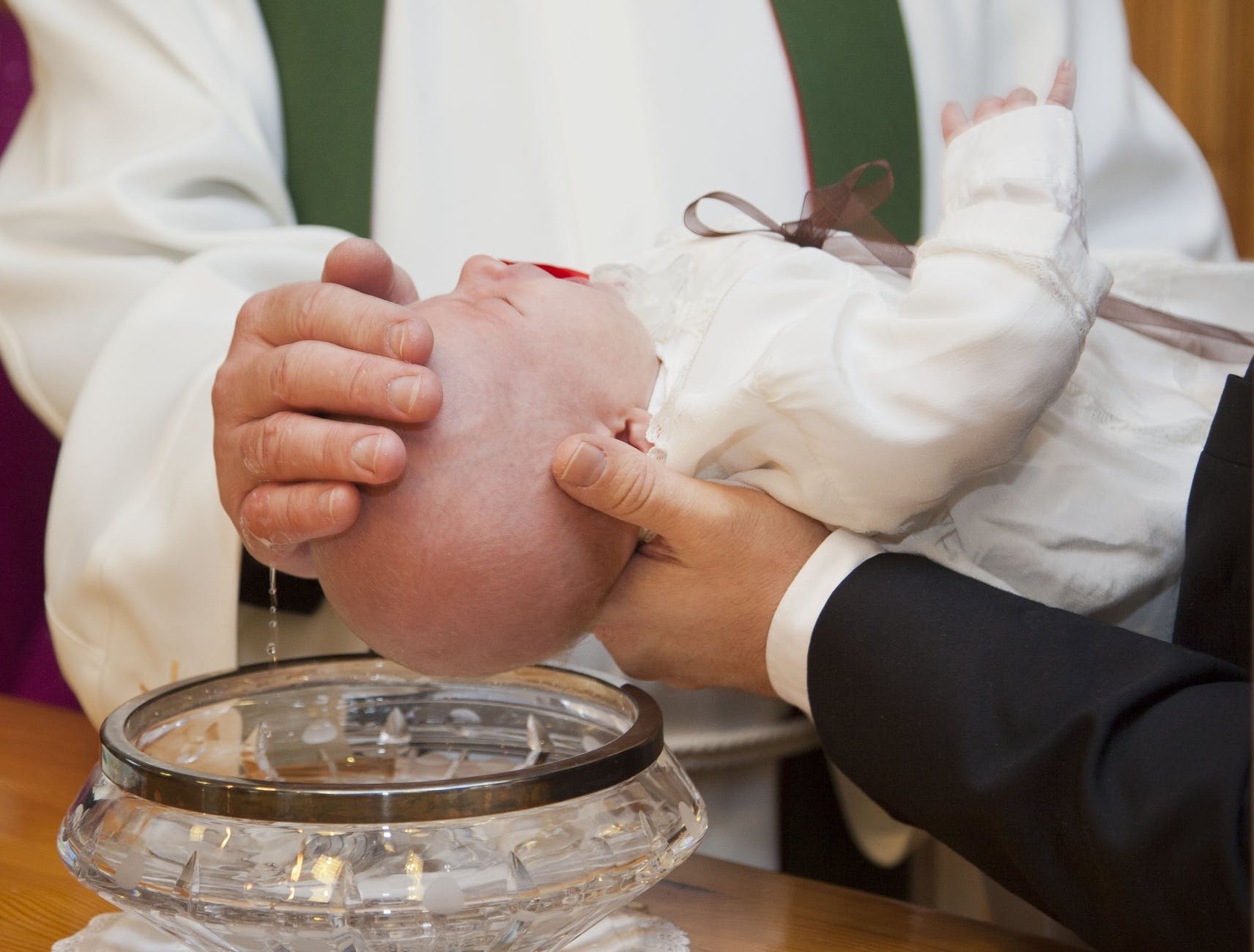
Through Baptism we are freed from sin and reborn as children of God; we become members of Christ, are incorporated into the Church and made sharers in her mission.[1] The First Sacrament of Initiation Baptism is the first sacrament that is received and makes it possible to receive all other sacraments.  Jesus Himself gave us this sacrament[2], as He gave us all seven sacraments.  Through Baptism, we become members of the Body of Christ, which includes all of our baptized Christian brothers and sisters – fellow Catholics, Orthodox Christians, and Protestant (denominational and non-denominational) Christians. The Waters of Baptism When Catholics read Scripture, we read the entire Bible as one book.  There are several times in the Old Testament in which we observe the prefiguring of Baptism.  As Moses led the Israelites out of slavery in Egypt, they came to the Red Sea and could not cross it until Moses stretched out his hand and parted the waters.  As the Egyptians crossed, the waters closed on them and drowned them (Ex 14: 21-30). Thus, through water were the Israelites given freedom from slavery and a new life, free to follow and worship The Lord.  Baptism grants us freedom from slavery to sin by washing away original sin and personal sin and births us into a new life with Christ.[3] When Joshua leads the Israelites across the Jordan River into the promised land which The Lord had given them (Josh 1:2-4), this symbolizes that the waters of Baptism lead us to the eternal life in Heaven that God has promised to those who follow Him.[4] St. John the Baptist preached a repentance of sin to prepare people for the coming of The Lord.  He baptized people in the Jordan River to symbolize this turning away from sin and turning toward God.  Jesus, in coming to be baptized, elevates this act from a symbol to a sacrament.  In every sacrament we encounter The Holy Trinity. This happens in Matthew 3:13-17: Jesus, the Holy Spirit descending like a dove, and the voice of God the Father. We encounter the Trinity Itself in the sacraments both physically and spiritually because God desires intimate union with us.[5]  In Baptism both original sin[6] and personal sin are washed away and our souls return to the state of grace that existed before the fall of Adam and Eve. (Sins committed after Baptism can be washed away by the Sacrament of Reconciliation.) The First Baptism in the Catholic Church The Catholic Church was born on the first Pentecost when the Holy Spirit descended on the apostles and the Blessed Virgin Mary.  From this very first day, Baptism has been administered.[7] In Acts 2:38, St. Peter tells the gathered crowd to repent and be baptized for the forgiveness of sins, and they will receive the gift of the Holy Spirit.   The Catholic Church continues this mission today.  For adults who wish to be baptized, they must complete instruction in several stages known as the Rite of Christian Initiation (RCIA). …

Continue ReadingBaptism

Purgatory

What is Purgatory? Purgatory is a place where souls go after death to be purified or “purged” of their sins.  Unlike Heaven and Hell, a soul does not stay here permanently.  Every soul is Purgatory will eventually go to Heaven.  Most people do not go directly to Heaven, but instead go to Purgatory first.  Only pure and holy things are allowed in Heaven, and since most people do not die in a state of grace (free from sin), they cannot go directly to Heaven.[1] Purgatory is a place of purification, a “purifying fire”[2].  When we sin, even though we are forgiven, the stain of sin is still on our souls.  We can purge this stain in this life through “penance”:  prayers, fasting, offering up sacrifices, offering up our suffering, acts of charity, and acts of mercy.[3] The amount of penance we do on earth has a direct correlation with the amount of time we spend in Purgatory.[4] An example may help in  understanding this concept.  A child arguing with his sibling at the table knocks over a glass of milk.  The child is instantly sorry.  He promises to behave at the table from now on.  The parent forgives the child, but there is still milk on the floor and it has to be cleaned up.  After we sin, we are (or should be) sorry and we promise not to do it anymore.  But the stain is still there.  Like the child with the milk, we can either immediately clean up the mess (by doing penance) or be stubborn and get stuck cleaning it up later when all our friends are outside playing (going to Purgatory instead of going directly to Heaven). Purgatory is not a joyful place. In Purgatory we see all of our unconfessed and unrepented sins in comparison to God’s holiness.  There is intense sorrow at the realization of our own sinfulness.  We suffer greatly at the horror of how many times we ignored God’s grace in our lives and deliberately neglected to do acts of kindness, charity, and mercy.  We are in agony when we realize how much God loves us and how little we loved Him in return.  There is unrelenting loneliness because we are fully aware that we are not in the presence of God, unlike the souls in Heaven who continually behold His face.  The purification received in Purgatory, while necessary, is extremely painful. Purgatory Really Exists Jesus spoke frequently of the existence of Purgatory and why souls are sent there.  In Matthew (5:21-26),  Jesus tells us that if we do not forgive others, we ourselves will be judged and thrown into prison (Purgatory) until the last penny is paid.  In Matthew 12:36, Jesus says that for every idle word we speak (gossip), we will be held accountable on the day of Judgement.  In Luke 12: 58-59, the individual is encouraged to make peace with his fellow man before they get to the judge lest the judge throw him into prison until the last…

Continue ReadingPurgatory

End of content

No more pages to load