Declare The Works of God And Give Thanks

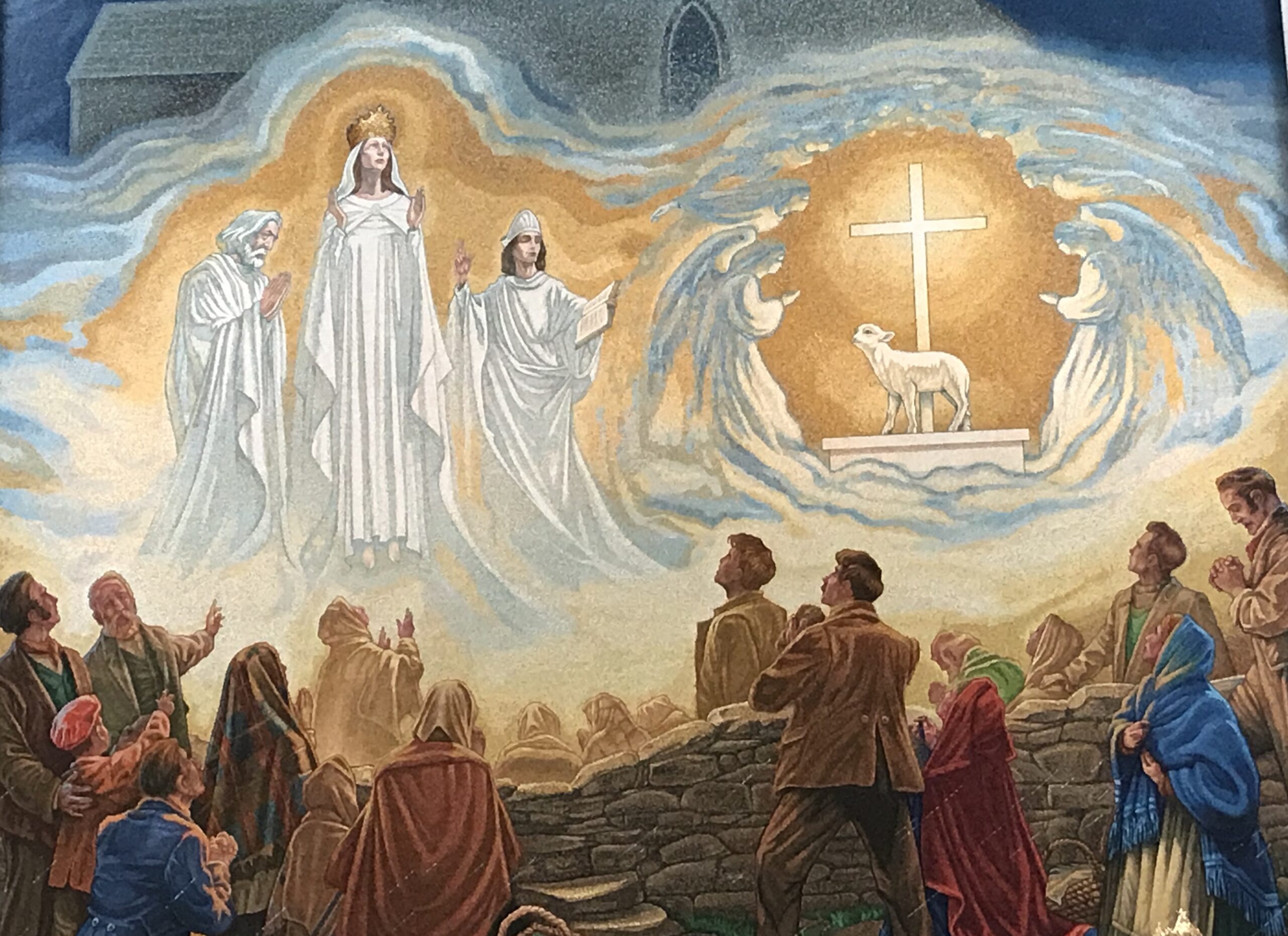
Raphael called the two of them aside privately and said to them: “Bless God and give him thanks before all the living for the good things he has done for you, by blessing and extolling his name in song. Proclaim before all with due honor the deeds of God, and do not be slack in thanking him.  A king’s secret should be kept secret, but one must declare the works of God and give thanks with due honor. (Tb 12:6-7) I recently returned from a trip and shied away from writing about my experiences because this isn’t a travel website nor is it about my personal life.  But after hearing the words of St. Raphael, the Archangel known for healing, it became clear that it’s not about me, but about the fingerprints of God and recognizing Divine intervention in even the most ordinary of circumstances because He loves us so much. After years of talking about a visit to Ireland, I finally sat down and planned it. I had heard about Knock, a place of apparition of the Blessed Virgin Mary.  I didn’t really know much about Knock, but felt a burning desire to go and knew I was being called there.  As with all pilgrimages, traveling there had its own ordeals, but our arrival was met with a sense of peace. On our first morning, we headed for the Reconciliation Chapel.  I knew the Holy Spirit was present because the priest understood things about me that we hadn’t even discussed.  He recommended that we attend the 3:00 Healing Mass at the Basilica and that we visit the museum. “Do it today,” he said.  At the healing Mass the priest called each of us by name and did the anointing and all the prayers of the Sacrament of the Sick.  Having three sacraments in one day was so amazing we didn’t even notice our jet lag.  I had a whole list of things to do at the Shrine, but the priest told us to go to the museum so we went.  It was like viewing a time capsule from 1879, and at the very back of the museum was a large binder full of hand-written letters in beautiful European script. For some reason I sat down to read the letters.  Some kind soul had transcribed in type-written form all 600 of them. People were pouring out their hearts about illnesses, accidents, and deformities.  In every letter the person described either rubbing a piece of mortar from the gable wall, or touching the wall, or putting the mortar in a glass of water and drinking the water.  All of them were miraculously healed.  600 verified miraculous healings between 1881-1884.  I had no idea this apparition site was a place of healing –it’s the Lourdes of Ireland.  We saw photographs of many crutches left at the gable wall because people had been healed.  I inquired about the mortar and was told that the portion of the gable wall where Blessed Mother, St.…

Continue ReadingDeclare The Works of God And Give Thanks

Our Father Who Art in Heaven

Over the years several Protestant friends have inquired about why Catholics have the body of Christ on the cross in our churches.  Our Protestant brothers and sisters display an empty cross in their churches because Christ resurrected from the dead.  For Catholics though, the cross means nothing without the sacrifice Jesus made for us.  The crucifix (Christ’s body on the cross) is central to our faith because His death saved us from our sins.  The shape of the church itself is a crucifix with the altar and tabernacle containing Christ at the head, and we the faithful sitting in the body. This is the simple answer, but it goes much deeper than this. Jesus did not only die for our sins so that we could go to Heaven, He left us the gift of the Eucharist so that we could become one with Him and thus become adopted children of God.  We the created become members of His uncreated family. At any Catholic church we are home. All Latin rite churches throughout the world have the same readings and the same prayers each day.  No matter where we are, we can walk into a Catholic church and pray the Mass without knowing the language.  This is the unity of one family.  It reflects the unity of the Trinity as one family. After the Our Father, we exchange the Sign of Peace with our brethren signifying that we forgive one another, which is another sign of unity, before turning to the altar and asking Jesus to forgive us for our own sins in the Lamb of God prayer. In presenting ourselves for Holy Communion we communicate our oneness in belief. When we partake of the Eucharist -- the Body, Blood, Soul, and Divinity of Jesus -- we all become one with one another just as all the branches are part of the same vine.  In the Eucharist, we receive the crucified and risen Christ and become one with Him, receiving a share in His inheritance as sons and daughters of God. Jesus alludes to this plan when He teaches the disciples to pray “Our Father Who art in Heaven” and when He reveals how this becomes possible in John chapter 6, known as the Bread of Life discourse: Jesus said to them, “Very truly, I tell you, unless you eat the flesh of the Son of Man and drink his blood, you have no life in you. Those who eat my flesh and drink my blood have eternal life, and I will raise them up on the last day, for my flesh is true food, and my blood is true drink. Those who eat my flesh and drink my blood abide in Me and I in them. Just as the living Father sent Me and I live because of the Father, so whoever eats Me will live because of Me. This is the bread that came down from Heaven, not like that which the ancestors ate, and they died. But the…

Continue ReadingOur Father Who Art in Heaven

Remain in Me

On Ash Wednesday I decided that for Lent I was going to focus on really improving one of my big flaws – and promptly everything that triggers that flaw was thrown at me. By Saturday I was in Confession telling the priest how poorly it was going. The priest gently stated that I was trying to do it myself instead of asking God to accomplish it in me. Oh, right. Message received. I responded, “Well Father, I guess I need to add pride to the list of sins in this confession.” While praying in front of the Blessed Sacrament afterward, Jesus put the scripture into my heart, “I must decrease and He must increase.” (Jn 3:30)  These were the words of St. John the Baptist, but suddenly I saw how it applied to me personally.  The key for me was to stop trying to depend on myself, and instead become like a child depending completely on God.  The more I got out of the way, the more God could work in me.  I suddenly saw clearly how the saints achieved such holiness.  They did not do it on their own, they instead relied on the Lord.  The more they emptied themselves, the more God filled them. They embraced humility and God did the rest. Then I recalled a story about the humility of St. John Paul the Great. At a retreat, a priest recounted his experience with Pope John Paul II when he was in seminary visiting Rome.  He had been instructed that the Pope would walk down the line and bless each of them and they weren’t supposed to converse with him because there were so many people and the Pope had limited time (according to them).  However, he had been on the street earlier that day and had met a beggar.  Embarrassed that he had no money to give, he offered to pray for the man.  The beggar then told him that he had been a priest.  The seminarian was so troubled about this that he blurted it out to the Pope when he came to bless him. The Pope instructed him to find the beggar and bring him to his personal office the following day. The seminarian brought the beggar. The Pope received him and asked everyone else to leave the room.  When the beggar came out of the room, tears were streaming down his face. The seminarian and the priests asked what the Pope said to him.  The beggar responded, “He sat me down in a chair and kneeled in front of me and said, “Father, will you hear my confession?” Because of the humility of this saint, the beggar subsequently returned to his priestly vocation. We are now at the end of Lent, entering the Holy Triduum. The Lord spoke again to my heart, “Remain in Me and I will remain in you”  -- a confirmation of His earlier message.  Just as a branch cannot bear fruit on its own unless it remains on the…

Continue ReadingRemain in Me

You Are The Salt of the Earth

Salt is an image that has been universally recognized throughout the ages and across all cultures.  As Christians we reflect on every meaning of salt and how we can apply it to our lives. Salt has the ability to transform the taste of food.  When I eat raw bok choy, I find that with a dash of sea salt, the bitter edge becomes sweet.  The secret to cooking with salt is to use just enough to bring out other flavors; one should not taste the salt.  How many times have we experienced the gift of salt from others?  The people who clean the altar linens at Church for Sunday Mass, parents who do all the prep work for preschool art class or sew costumes for school plays, or the hosts and hostesses who prepare their homes to welcome holiday guests all do much more than we realize.  They are the salt that brings beauty to our lives. Salt is humble.  It remains in the background not driven by need for recognition.  St. Thérèse of Lisieux is a perfect example. As a cloistered nun, she remained apart from society devoted to a life of prayer.  In her time very few people knew of her existence or the profound effect she would have on Christianity. She died at 24 years of age in 1897.  Her spiritual essays, collectively published as The Story of a Soul in 1898 outline a path to holiness that is so simple a child could grasp it: do all the little things with great love.  As a mom raising young children I would have loved to say that I rose early every morning to pray a rosary before starting my day, but that was not my reality. My children did not nap and my younger one slept very poorly for years – which meant I slept poorly as well, tumbling into bed at night exhausted and falling asleep during the Apostles’ Creed; I hoarded every minute of sleep as a treasure.  St. Thérèse’s words showed me how to make a prayer out of my ordinary life. Whether I was doing laundry, scrubbing the toilet, or cooking a meal, I could offer these things to God with love and they would no longer be menial tasks, but prayers from the heart. Her advice transformed my perspective not only on what I was doing, but on how I valued myself and my contribution to the world.  I no longer saw myself the way American society views parents who work in the home; I saw myself as someone accomplishing the tasks God wanted me to do for love of Him and my family.  I found meaning in the smallness of my life. Salt is vital for life. Salt helps regulate the water content in our bodies, helps maintain blood pressure, and assists in nerve and muscle function.  Without salt, we could not survive.  If we are to be this salt, we must understand that without Christ we have no eternal life…

Continue ReadingYou Are The Salt of the Earth

End of content

No more pages to load