
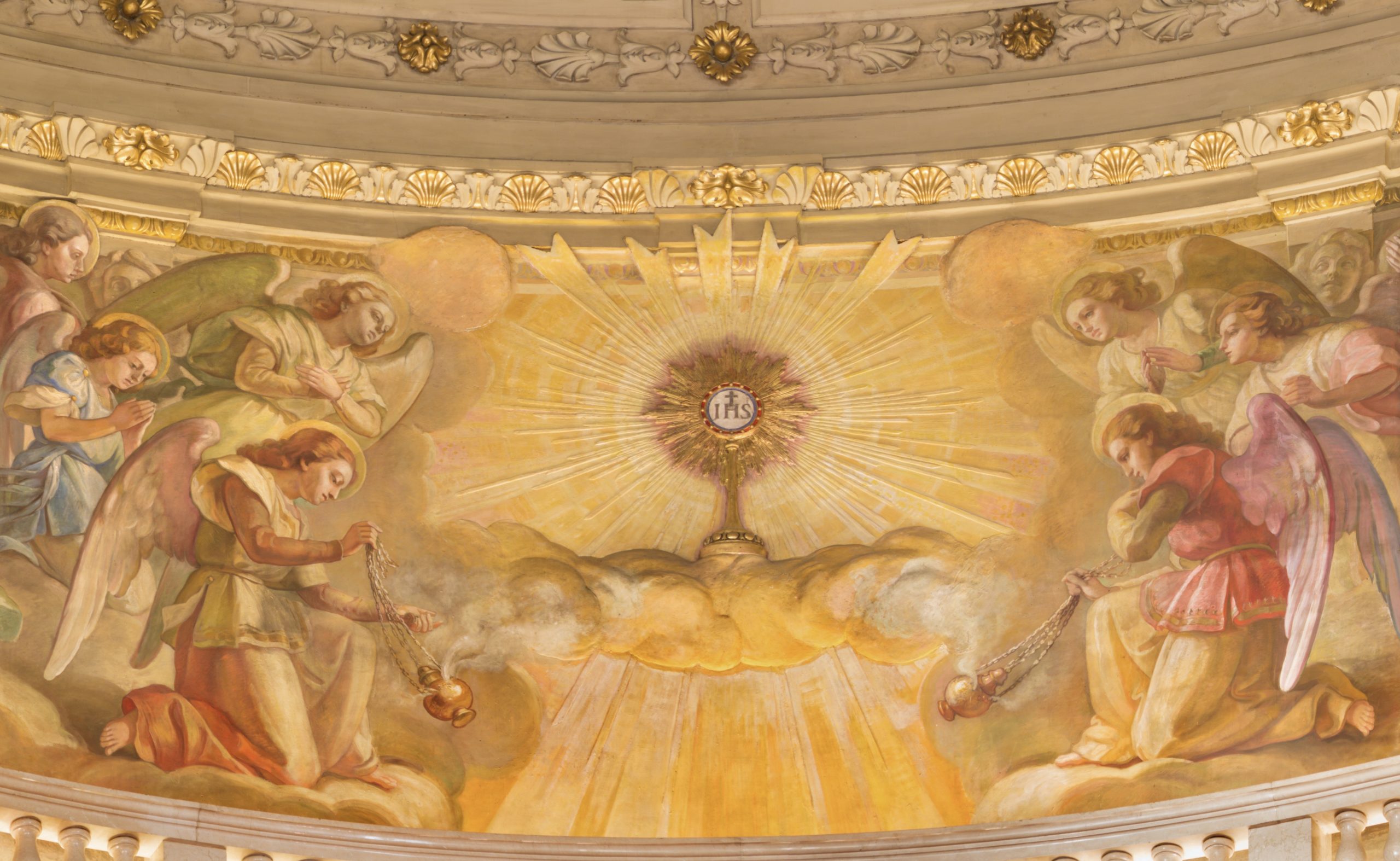
Eucharist
From the Question Box: If Jesus is in the bread, why do we eat Him? This question touches the heart of our faith and ponders the very nature of who God is and what His relationship with us is. The people of Jesus’ time asked this question as well. To begin to understand this mystery, which is the very center of our faith, we need to contemplate several theological truths. First, consuming the Eucharist is not cannibalism. The Catechism of the Catholic Church tells us in paragraph 1367 that the sacrifice of Christ and the sacrifice of the Eucharist is one and the same, although the manner of offering is different. The Eucharist is a non-bloody sacrifice. The Eucharist makes present the sacrifice of the Cross and applies its fruit: everlasting redemption (CCC#1366). Second, we consume the Eucharist because Jesus told us to do so. Jesus reveals the Eucharist to us in John 6: 51 – 58: “I am the living bread which came down from heaven. If any one eats of this bread, he will live for ever; and the bread that I will give, is my flesh, for the life of the world. The Jews then disputed among themselves, saying: How can this man give us his flesh to eat? Then Jesus said to them: Amen, amen I say unto you: Unless you eat the flesh of the Son of man, and drink his blood, you have no life in you. He who eats my flesh, and drinks my blood, has eternal life: and I will raise him up in the last day. For my flesh is food indeed: and my blood is drink indeed. He that eats my flesh, and drinks my blood, abides in me, and I in him. As the living Father has sent me, and I live because of the Father; so he that eats me, will live because of me. This is the bread that came down from heaven. Not as your fathers ate and died; he who eats this bread, will live for ever.” To comprehend what He is telling us, we need to look at God’s revelation to us in the Old Testament. We must realize that the entire Bible should be viewed as one book, one tapestry if you will. Just as colors are woven into a beautiful cloth and each color enhances the entire picture and contributes to the images, so too each book of the Bible contributes to our understanding of the truths God has revealed. One must look at the entire Bible to understand the context and meaning of each book. Just as removing one color from the tapestry removes depth, beauty, and meaning from the picture, so too we need every book in the Bible to understand what God is revealing to us. Our first encounter of bread and wine being offered is in Genesis when Melchizedec, the King of Salem (Salem means peace and we refer to Jesus as “the Prince of Peace”), appears to…